Plain Sight

Be Found. Be Recommended.

We build custom-coded websites for local businesses.

Each one is written for the people who visit it and for the AI tools that now recommend businesses to them.

More people ask ChatGPT, Claude, Gemini, or Perplexity which business to hire. Those tools recommend the businesses they can read and check. We write every page in code, so your services, location, hours, and credentials are stated in a form software can parse.

best contractor in Marin?

We don't cram a business into a template.

Every build starts the same way, by getting to the essence of the brand before a single page is designed. What does this business actually do better than anyone nearby, and how would you say that out loud? Once we know, the job is to communicate it plainly.

That's the argument for custom code. A template decides in advance what your business is allowed to look like and how it's allowed to be described, and every business that buys it gets the same shape. Writing the code ourselves means the structure can follow the business rather than the other way around, and it means the machine-readable layer underneath is ours to build properly rather than something we work around.
Built in code, not on a template.

Most small business websites are made with page builders like Squarespace, Wix, or Webflow. They're quick to set up. They also add scripts and styling the business doesn't control, and they limit what can be written into each page for software to read.

We write the HTML ourselves. The site loads fast, says exactly what the business does, and gives AI tools a clean copy of every fact. You own every file, and it runs on any host.

NAMEHOURSSERVICESLOCATIONPRICES

What AI reads on every page

How a template site compares with a Plain Sight site
Area Typical template site Plain Sight site
What AI crawlers read Many AI crawlers read the HTML a server sends and don't run JavaScript. Anything a builder loads with scripts can be missed. Every word and every fact is in the HTML the server sends. Nothing waits on a script.
Structured data Generic markup generated by the platform, the same for every customer. Written for each page. Structured data is code that labels the business, its services, its people, its prices, and its FAQs so software doesn't have to guess.
Instructions for AI tools Little or no control over robots.txt, and often no llms.txt. A robots.txt that names each AI crawler, an llms.txt file that summarizes the business for AI tools, and a sitemap of every page.
Page structure The template decides what pages exist and how they're laid out. The structure follows the business. Every service gets its own page and its own address.
Speed Builder code loads on every page, whether the page uses it or not. Plain HTML and CSS, with only the code each page needs.
Ownership You rent the platform. Leaving means rebuilding. You own the code, the writing, and the accounts. The files run on any host.

You don't need to edit code to keep the site current. We can add a simple editor for the pages you'll change often, like news, menus, or project galleries.

The audit, the build, then ongoing work.

AI tools can only recommend a business they can read, verify, and link to. Most businesses fail at least one of those three tests, and which one it is changes everything about where the work should go.

Readable

A website that both a person and a machine can understand. We design for the reader first, because a site that doesn't move a human being won't be saved by markup. Then we make sure the message and the value are stated in a form software can parse, with every service on its own page and its own address.

Verifiable

A business an AI can verify. Your name, address, phone number, license, and profiles stated the same way on every page, in the code software is built to check, and matching what the rest of the web says about you.

Citable

A business an AI can cite. Something specific to link to when someone asks about the exact thing you do, rather than one page that covers everything at once.

01

The audit

Thirty-three checks across five weighted dimensions, run against your website and the listings carrying your name. This is the part that gives us the keys to the castle. It shows which of the three tests you're failing and by how much, so the work goes to the things actually costing you visibility. Everything after it is scoped from what it finds.

02

Website build

A custom-coded site with a real page for each service. Every page carries structured data stating your address, hours, license, and profiles. The site ships with a robots.txt, an llms.txt, and a sitemap, so AI tools know what it is and where each page lives. Three to five weeks.

03

Ongoing optimization

This is where the work starts compounding. Every month the same 33 checks re-run, so drift gets caught early: a page that falls out of date, a change in how AI tools read websites, a competitor who just did the work. Then we fix the top items and add the pages and answers that are missing. Each month starts from a stronger position than the last.

Listings on Google, Apple Maps, Yelp, Bing, and industry directories are handled by our sister company, Studio B. None of this is only for AI. The same structure is what ordinary Google search and Google Maps have rewarded for years.

If you don't shape the narrative, you don't control how you're seen.

Even when customers hear about you through word of mouth, they still validate what they've heard. They search. They ask AI: 'Is this company any good?' AI answers using whatever it can find.

If your presence is any of these things, the picture AI forms isn't reliable:

Outdated Incomplete Fragmented Shaped by competitors Simply missing

We make sure the right story is found, and understood. Your story.

DIRECTORYREVIEWSARTICLESWEBSITE

AI cross-checks every source

Good work deserves to be found.

Your work may speak for itself, but first, people have to find it. Search has changed. It no longer returns a list of options to sort through. It interprets what's available and delivers a single recommendation. Most businesses were built for the old model. If your business isn't understood, it isn't recommended.

Before

You compared options. Websites were designed to be browsed.

Now

You're given a recommendation. Businesses need to be interpreted.

How AI decides which businesses to recommend, and what it takes to be one of them.

Video, media buying, and listings go to Studio B.

Studio B is our sister company in Northern California. It makes the ads, buys the media, and keeps your listings accurate. When a Plain Sight website needs a video, a campaign behind it, or listings cleaned up across the web, Studio B does that work. The two companies work together, so the website, the ads, and the listings all say the same thing.

  • Video and content TV commercials, streaming spots, social video, photography, and motion graphics.
  • Media buying Streaming TV, broadcast, cable, radio, Facebook, Instagram, and outdoor, targeted by city and ZIP code.
  • Listings Google Business Profile, Apple Maps, Bing Places, Yelp, and industry directories corrected and kept consistent.
Visit Studio B →
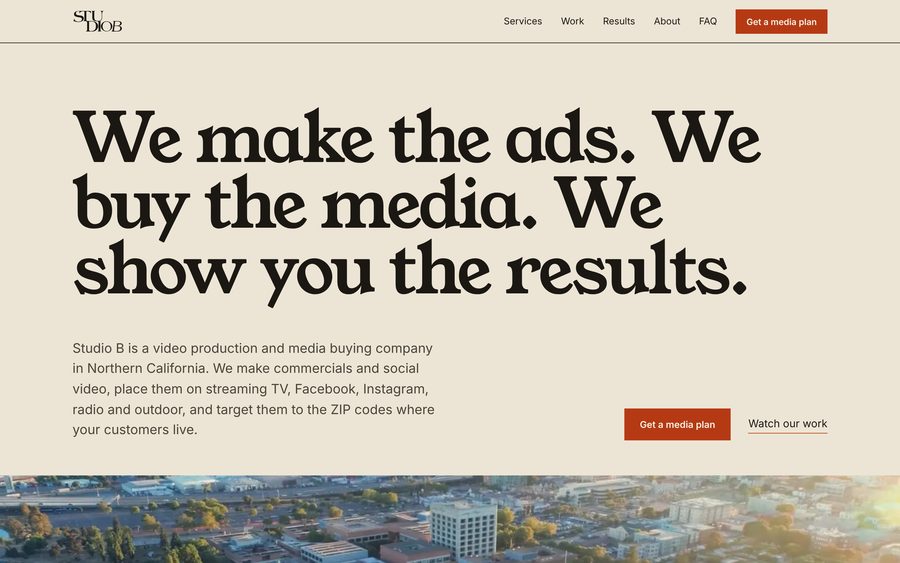
Studio B home page, showing the headline We make the ads. We buy the media. We show you the results. studiobworldwide.com →

We partner with established businesses that value clarity over noise.

They understand that visibility today isn't just about being seen. It's about being understood, trusted, and recommended. They're ready to be recognized and chosen for the work they already do well.

Ready to see how your business actually shows up?

Schedule a Visibility Assessment.

We'll show you what search and AI see today, where visibility and opportunities are being lost, and what to fix first. Clear insights. No pressure.

Schedule a Visibility Assessment

Frequently asked questions.

Plain Sight helps businesses across the San Francisco Bay Area, including San Francisco, the East Bay, Marin, and Sonoma County, improve how they are seen, understood, and chosen.